Humanoid Secures Partnership with Bosch Following a Successful POC
London, UK, May 21, 2026 — Humanoid, a UK-based AI and robotics company, today announced a partnership with Bosch, marking the transition to scaled production of humanoid robots. The agreement follows the successful completion of a joint proof of concept (POC) in March 2026, where Humanoid’s platform demonstrated full capability in a complex industrial workflow.
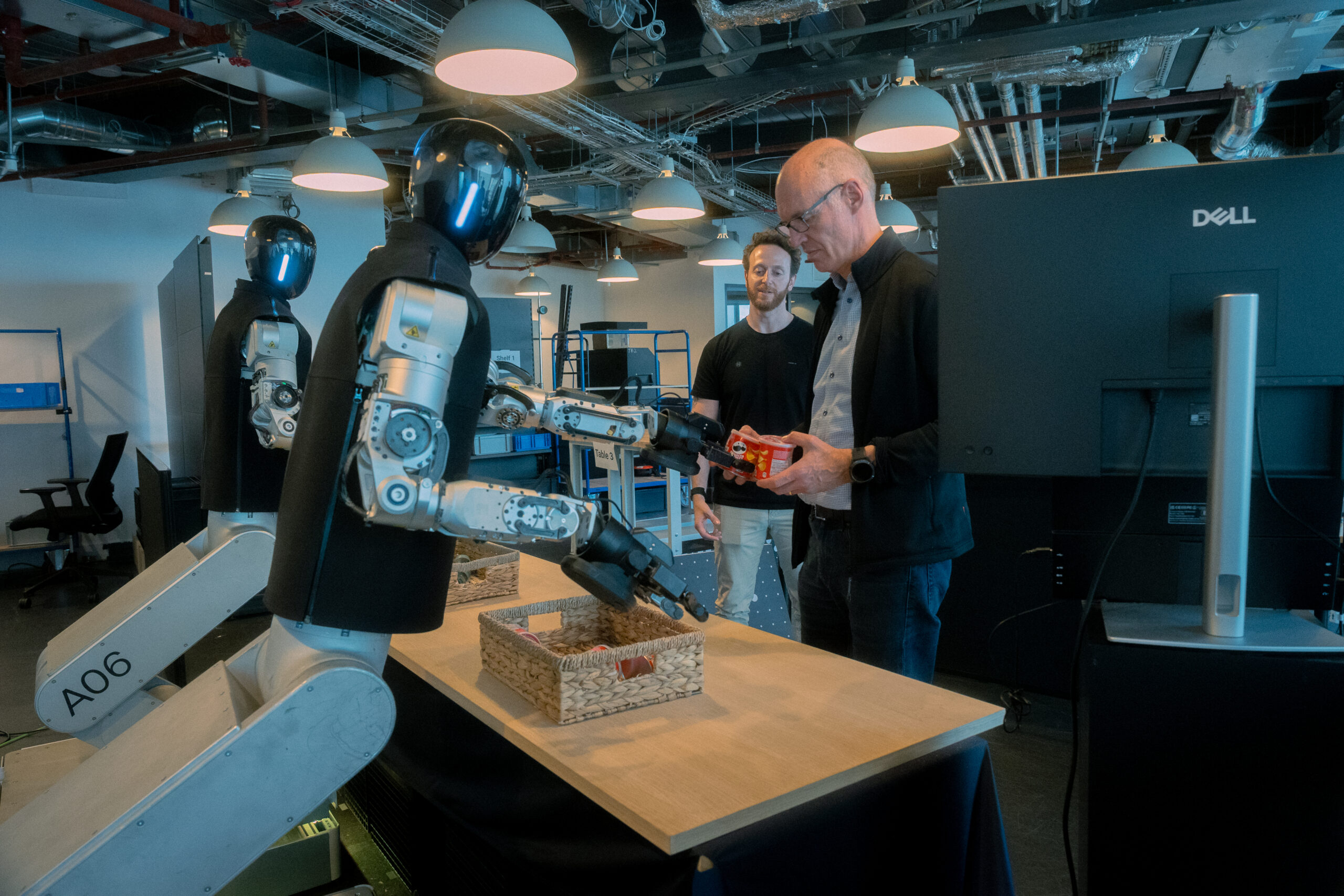
Dr. Mathias Pillin, CTO of Robert Bosch GmbH, and Sotirios Stasinopoulos, CPO of Humanoid, during a test of HMND Alpha’s handling.
The POC focused on an intralogistics use case: HMND 01 robots autonomously transferred boxes from a conveyor to a trolley in Bosch’s dynamic logistics environment in Bühl, Germany. The POC involved handling 5 different box sizes across multiple footprints, heights and varying weights. The project’s goals included developing advanced scanning and handling capabilities, managing inputs from multiple conveyors, and demonstrating system adaptability in dynamic environments. Orchestrated through KinetIQ, Humanoid’s proprietary AI framework, the POC achieved its objectives, confirming both the technical readiness and scalability of the approach.
Humanoid, a UK-based AI and robotics company, today announced a partnership with Bosch, marking the transition to scaled production of humanoid robots. The agreement follows the successful completion of a joint proof of concept (POC) in March 2026, where Humanoid’s platform demonstrated full capability in a complex industrial workflow.
Following these results, Humanoid and Bosch have entered into a manufacturing agreement to support the production of HMND 01 humanoid robots for the European market. As Humanoid pushes toward large-scale commercialisation, the company is investing in Design for Excellence — including Design for Manufacturability, Reliability, Serviceability, and Cost — to ensure its platform delivers exceptional long-term performance and economic value for its customers.
Under the agreement, Bosch will serve as Humanoid’s contract manufacturing partner, while also providing strategic oversight and technical expertise through a structured Design for Excellence (DfX) framework spanning hardware design, production, supply chain, and cost optimization.
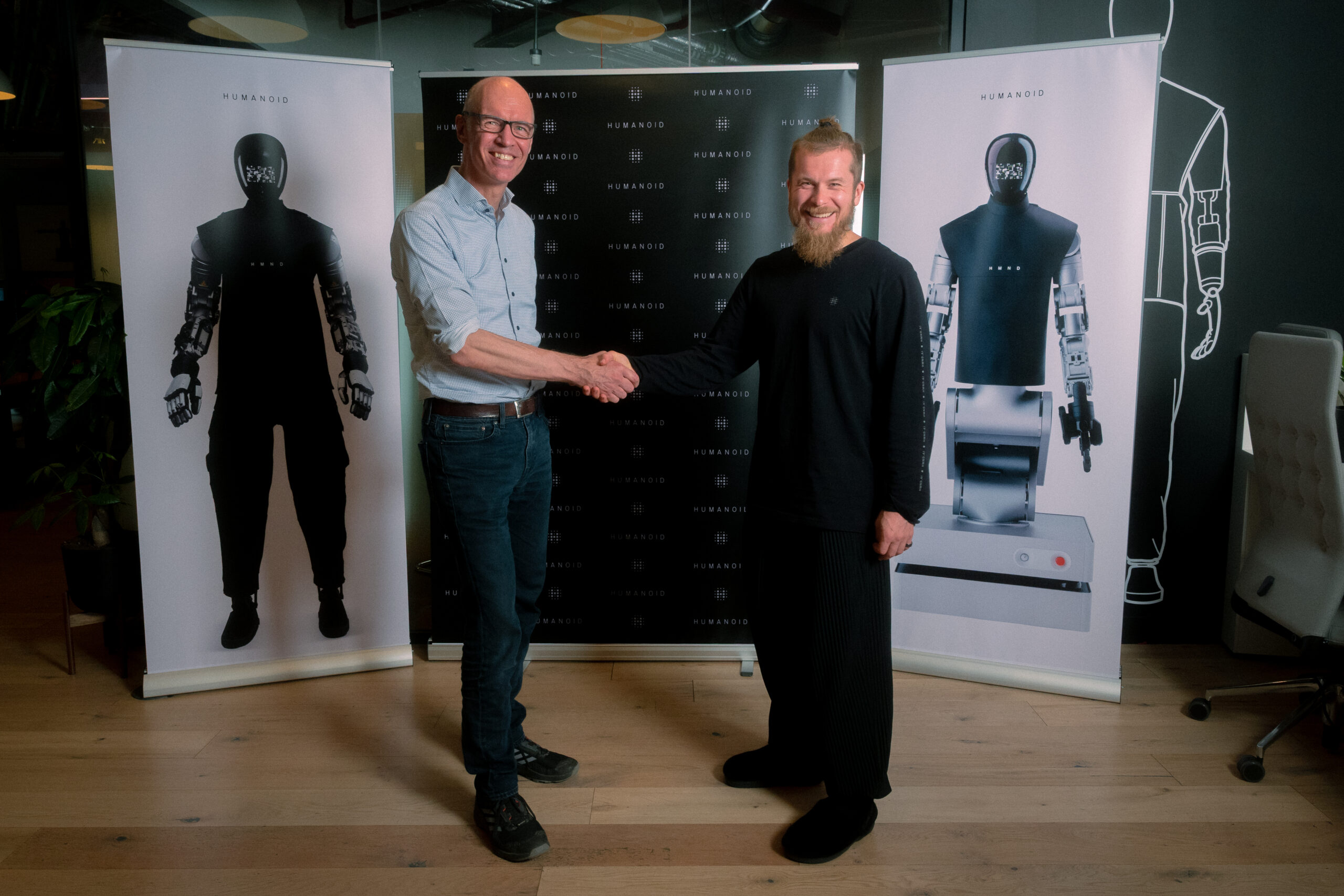
Dr. Mathias Pillin, CTO of Robert Bosch GmbH, and Artem Sokolov, CEO and Founder of Humanoid.
“For Humanoid, this agreement is a critical step in our roadmap, bridging the gap between POC validation and large-scale deployment. Our goal has always been to shorten the path between innovation and real-world integration, and this agreement reflects that approach. Together with Bosch, as a strong strategic manufacturing partner, we are committed to bringing humanoid robots into industrial settings, scaling their deployment, and accelerating adoption across logistics, manufacturing, and beyond,” said Artem Sokolov, Founder and CEO of Humanoid.
“This partnership is built on the shared belief in the great potential of robotics in industry”, said Peter Svejkovsky, Head of Corporate Intellectual Property. “Bosch’s goal is to advance the scaling of humanoid robotics and to further develop this field of the future. With our global production infrastructure and deep industrialisation expertise we are the perfect partner to take the step from prototype to volume manufacturing.”
Alongside the manufacturing partnership and early deployment, the two companies will also explore the integration of Bosch technologies and advanced components into future versions of the HMND 01 platform.
Bosch and Humanoid teams at the Humanoid office, May 2026.
About Humanoid
Humanoid is a UK-based robotics company building humanoid robots for industrial use, working to become the #1 general-purpose industrial humanoid robotics company within two years. Founded by Artem Sokolov in 2024, Humanoid brings together over 200 engineers, researchers, and innovators from top global tech companies. All robots run on KinetIQ, Humanoid’s proprietary four-layer AI framework designed for real-world deployment.
With offices in London, Boston, and Vancouver, the company is focused on building commercially viable, scalable, and safe robotic solutions for real-world applications. For media inquiries, interviews, or further information, please contact: og@thehumanoid.ai
Humanoid Secures Landmark Deal with Schaeffler to Deploy Thousands of Humanoid Robots
London-based startup to put Humanoid Robots on Schaeffler’s factory floors
Deployment begins in live German production environments in late 2026
Schaeffler becomes preferred actuator supplier
London, UK, May 13, 2026 — Humanoid, the UK-based AI and robotics company, has signed a binding, phased deployment and supply agreement with Schaeffler, a leading Motion Technology Company, to integrate humanoid robots directly into live manufacturing operations. The first systems go live in Germany before the end of 2026. Humanoid will also purchase actuators from Schaeffler as a preferred supplier.
The agreement is one of the largest disclosed humanoid robot rollouts ever announced and positions Humanoid, founded by Artem Sokolov in 2024, among the youngest companies to secure a large-scale contract at this level. It targets deployment of a four-digit number of wheeled units across Schaeffler’s global facilities by 2032.
Schaeffler and Humanoid Partner to Bring Physical AI to the Factory Floor
Deployment phaze across Schaeffler sites
The agreement follows a series of successful proof-of-concepts and a strategic partnership announced in January 2026 between the two companies. The initial deployment phase, running from December 2026 through June 2027, will take place across two Schaeffler sites in Germany. In Herzogenaurach, the focus will remain on advancing box handling use case within a live production environment. At the same time, operations in Schweinfurt will begin with a three-month capability demonstration and integration testing period, followed by a three-month on-site phase dedicated to validating stable, continuous operation approaching full production scale.
A core principle of the collaboration is economic viability at scale: Humanoid will support Schaeffler in integrating its robotic systems into existing production environments. This includes meeting Schaeffler’s requirements for system architecture, safety, and IT infrastructure, as well as aligning with standardized rollout processes and security-by-design principles.
Strategic Deployment and Supply Agreement
The agreement is structured around a Robot-as-a-Service (RaaS) model. Under this model, Humanoid provides the robotic systems together with the related services required for end-to-end deployment and operation, including connection to the fleet management software, maintenance, 24/7 technical support, updates, and ongoing performance management.
In addition to the deployment contract, Humanoid has also signed a 5-year supply agreement with Schaeffler for supply of actuators. Under this agreement, Schaeffler will become Humanoid’s preferred supplier, covering more than 50% of the company’s demand for joint actuators for its wheeled-based platforms through 2031. This partnership is expected to translate into the supply of a seven-digit number of actuators.
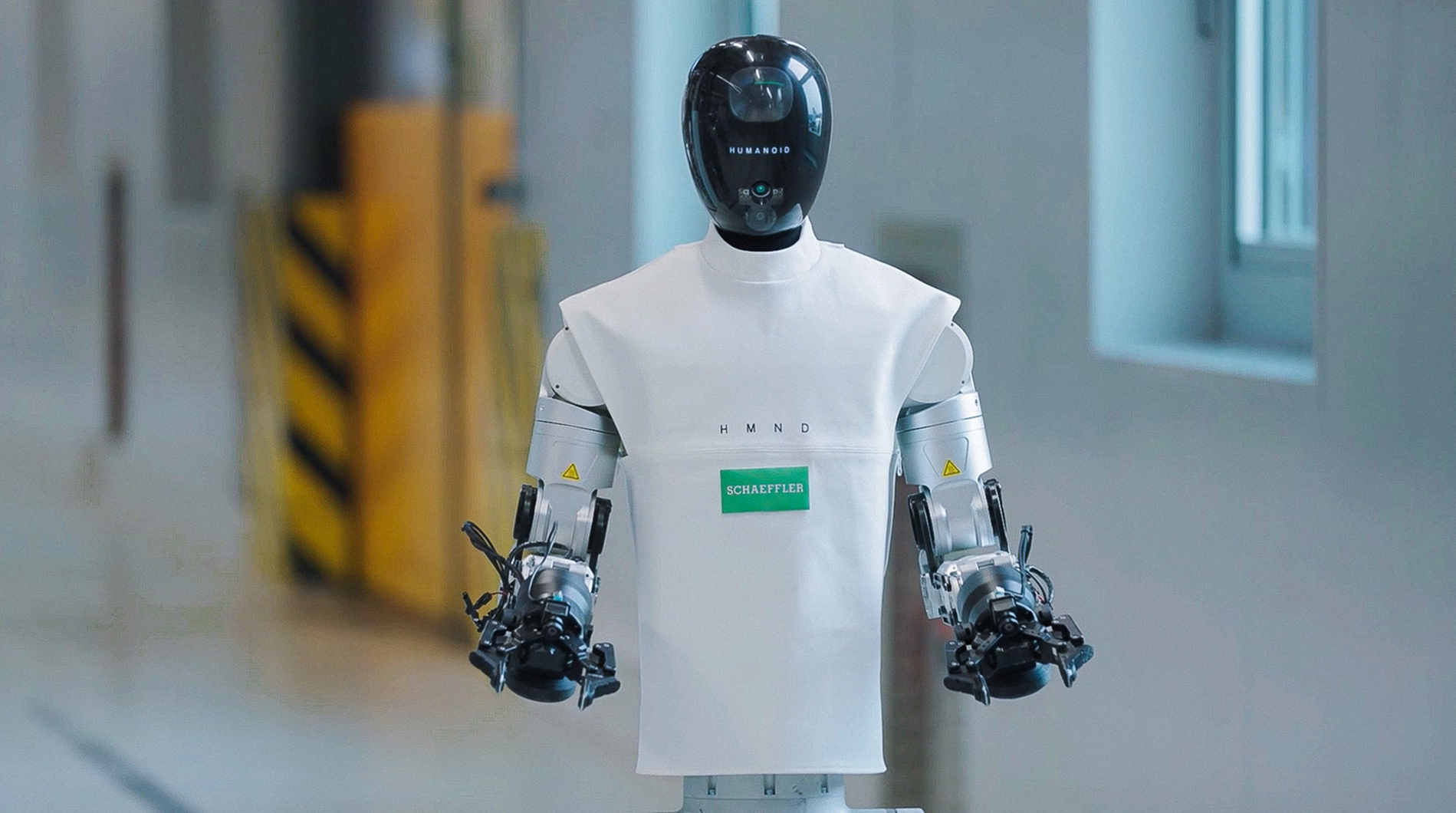
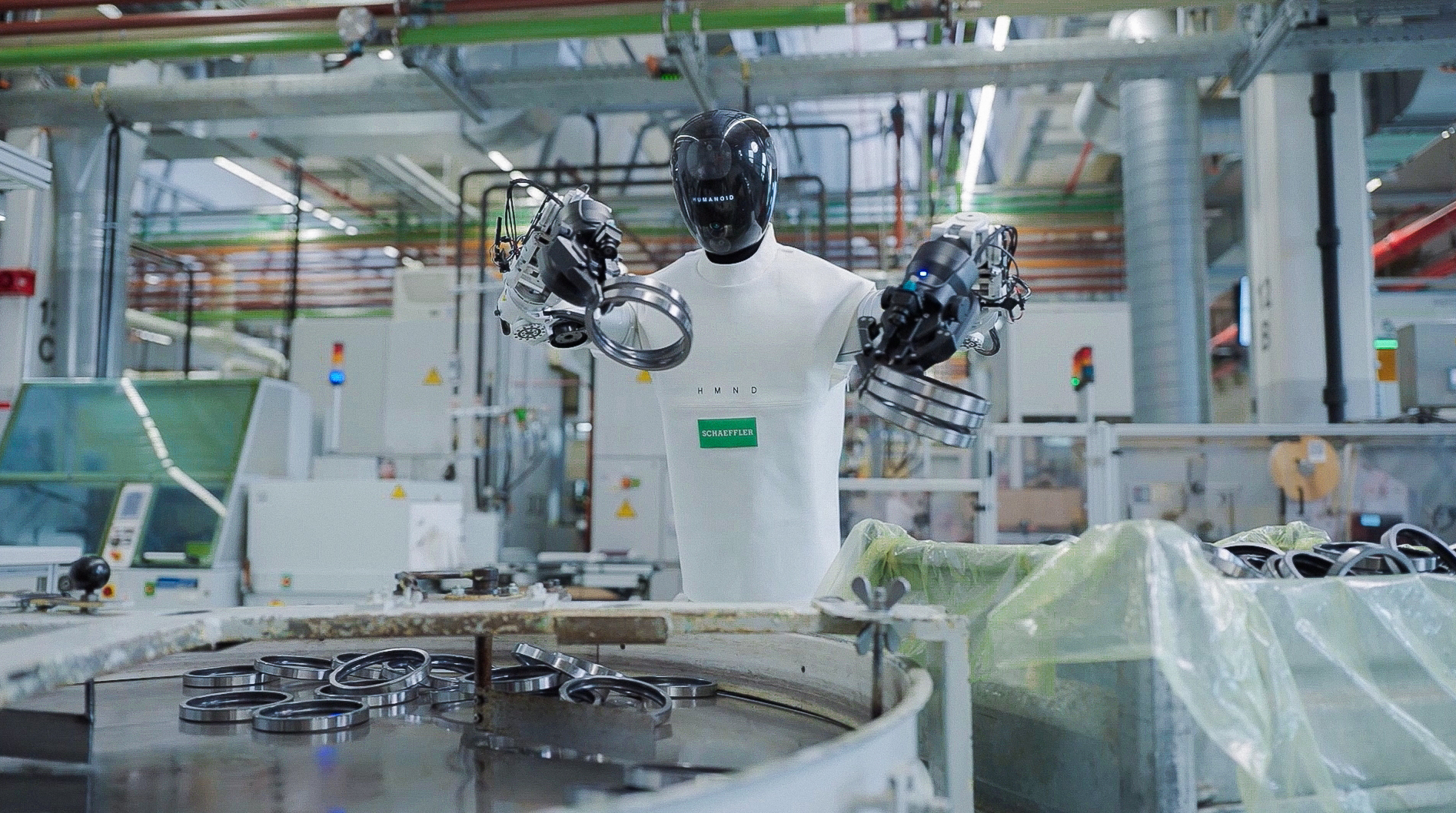
HMND 01 Operating at Schaeffler’s Facility in Germany
“Together with Schaeffler, one of our key industrial partners, we are taking an important step toward making humanoid robotics part of global manufacturing operations,” said Artem Sokolov, Founder and CEO of Humanoid. “We have already seen strong results from our proof of concept together, and now we are taking the next step to staged deployment. Moving into real-world operations is where the true value of humanoid robots is proven.”
Dr. Jochen Schroeder, Chief Operating Officer at Schaeffler AG, said: “The partnership with Humanoid underscores Schaeffler’s position as a trusted technology partner in advanced robotics. By supporting the phased deployment of humanoid systems in real manufacturing environments and serving as a preferred supplier of actuators, we are contributing to the industrial scaling of this technology while further strengthening our role in future-oriented motion solutions.”
Following the initial stages, both companies will continue to assess performance, expand deployment across the whole value stream including dexterous tasks as assembly and packaging in future.
About Humanoid
Humanoid is a UK-based robotics company building humanoid robots for industrial use, working to become the #1 general-purpose industrial humanoid robotics company within two years. Founded by Artem Sokolov in 2024, Humanoid brings together over 200 engineers, researchers, and innovators from top global tech companies. All robots run on KinetIQ, Humanoid’s proprietary four-layer AI framework designed for real-world deployment.
With offices in London, Boston, and Vancouver, the company is focused on building commercially viable, scalable, and safe robotic solutions for real-world applications. For media inquiries, interviews, or further information, please contact: og@thehumanoid.ai.
Siemens and Humanoid bring Physical AI to the factory floor: deploying humanoids in industrial operations with NVIDIA
Siemens’ and NVIDIA’s strategic partnership to build fully AI-driven, adaptive manufacturing sites delivers real-world milestone with testing of humanoid robot at Siemens factory in Erlangen, Germany
HMND 01 Alpha is purpose-built for industrial environments with advanced manipulation capabilities
Siemens Xcelerator offers a factory-grade scalable portfolio for industrial integration
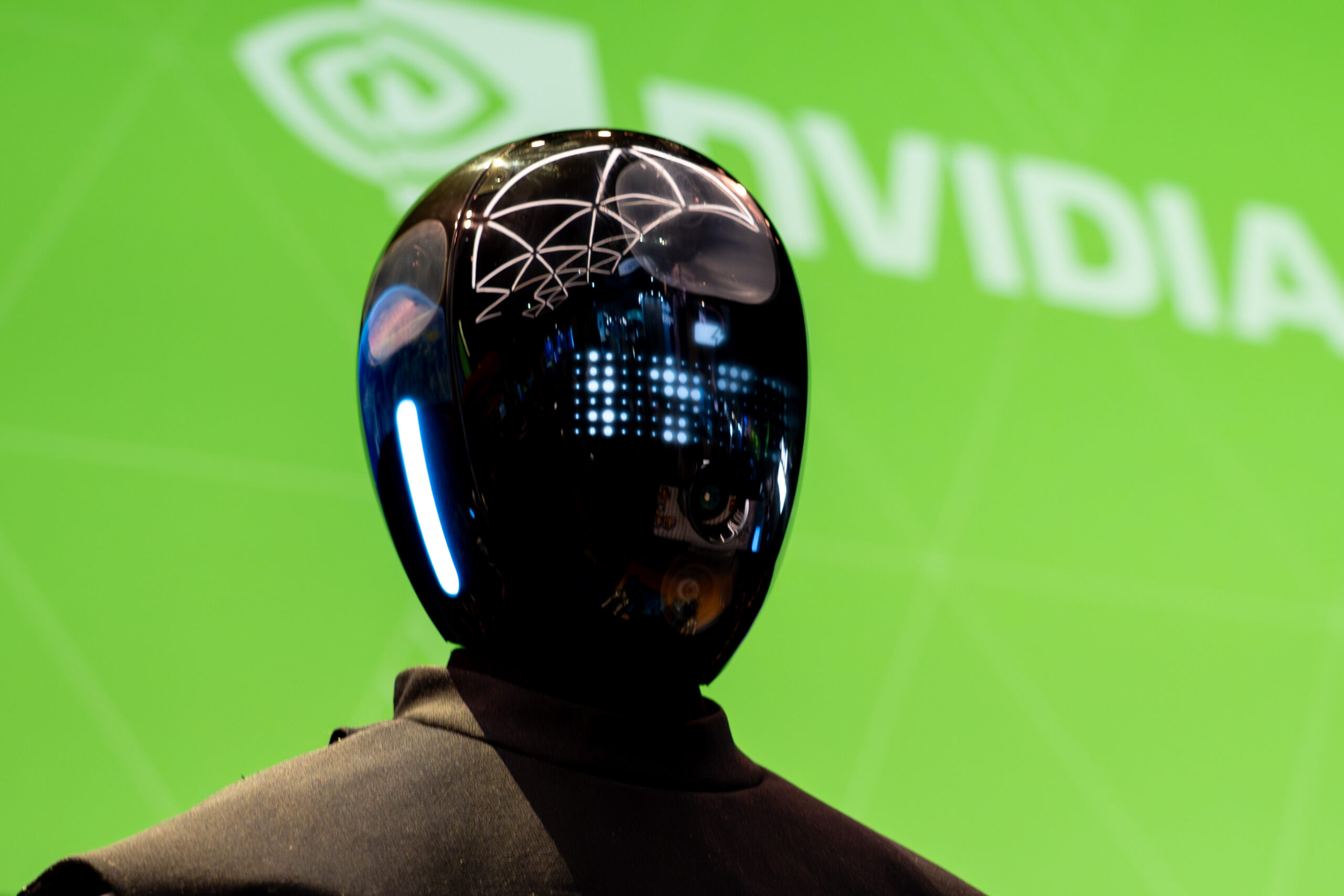
NVIDIA accelerates simulation and development for faster deployment
Siemens and Humanoid today announced a landmark milestone in the journey to bring physical AI from vision to industrial reality. Humanoid’s HMND 01 wheeled Alpha humanoid robot, built using the NVIDIA physical AI stack, has been successfully tested in operations at Siemens’ electronics factory in Erlangen, Germany, performing autonomous logistics tasks. This builds on the Siemens and NVIDIA strategic partnership, announced at CES, to build the world’s first fully AI-driven, adaptive manufacturing sites.
The dawn of physical AI in manufacturing
Physical AI – the discipline of training intelligent machines to perceive, reason and act in the physical world – is poised to transform how goods are made. Bridging the gap between AI research and the demands of a real factory requires a high-performing ecosystem: world-class AI compute and simulation, a proven robotics platform, and the deep industrial automation infrastructure to tie it all together.
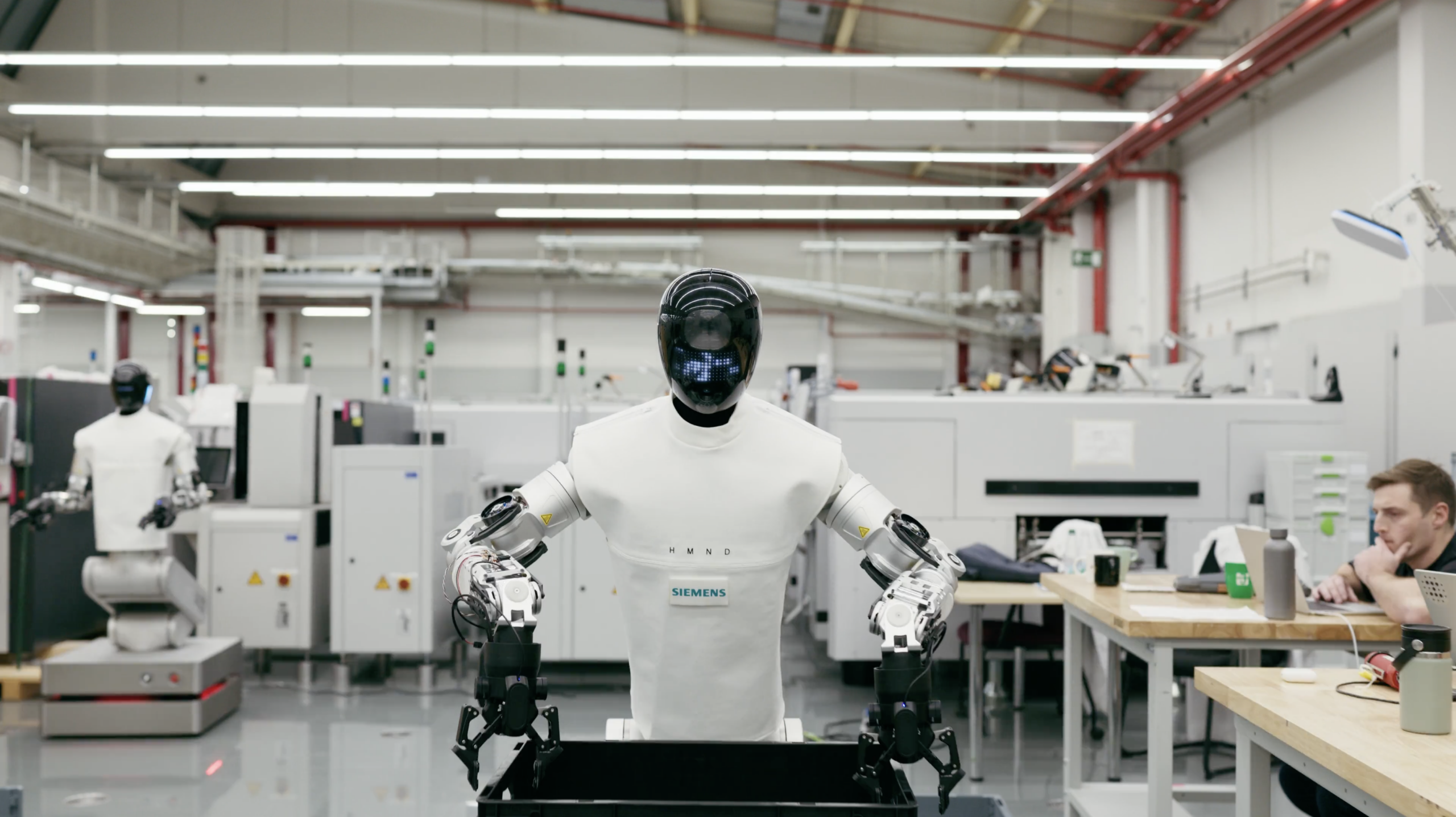
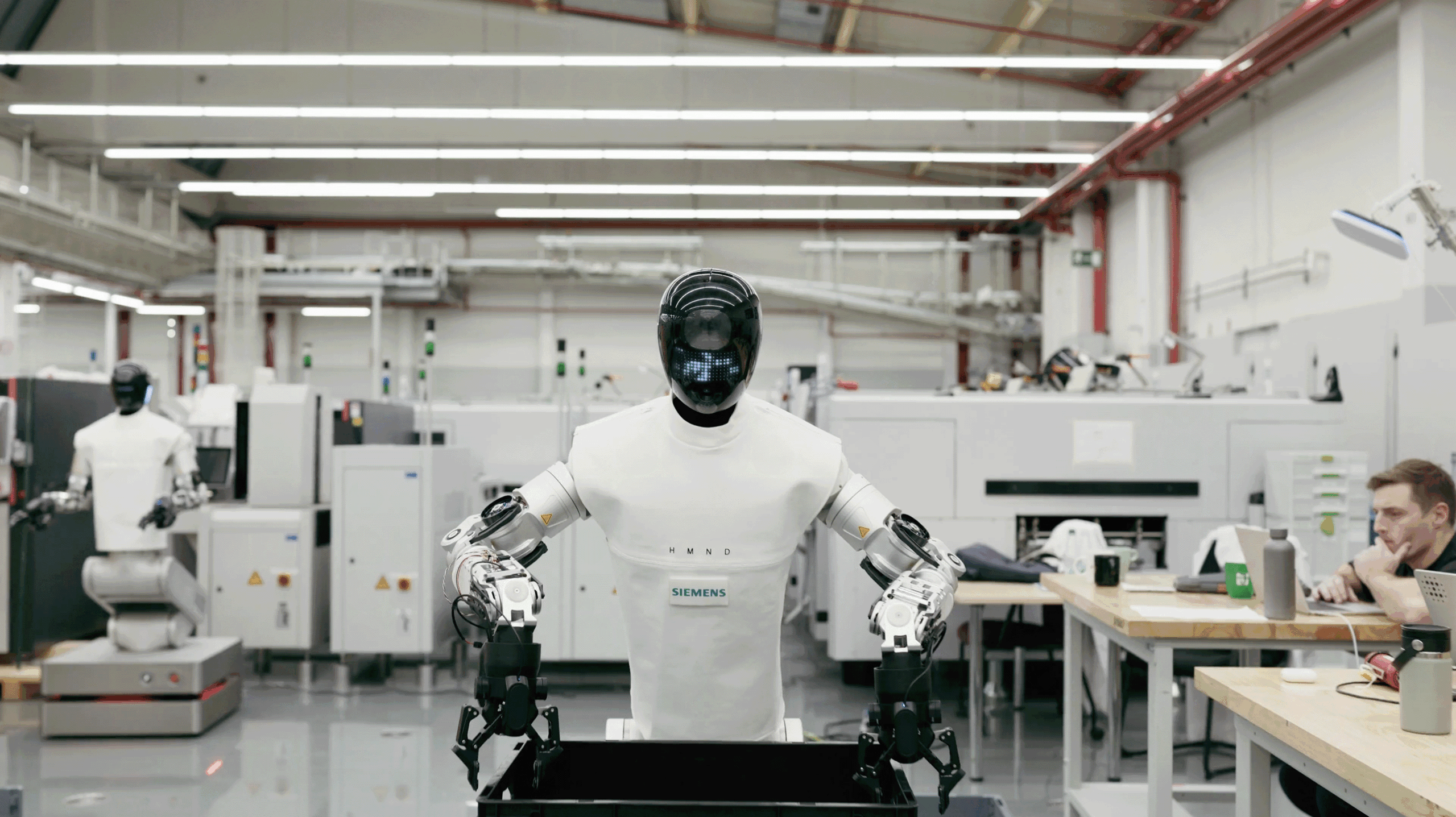
The HMND 01 Alpha robot was deployed in Siemens’ logistics operations, where it autonomously executed tote-handling tasks – picking, transporting and placing containers for human operators. All target performance metrics were met, including a throughput of 60 tote moves per hour, uptime exceeding 8 hours, and autonomous pick-and-place success rates above 90 percent.
Siemens and Humanoid Bring Physical AI to the Factory Floor: Deploying Humanoids in Industrial Operations with NVIDIA
Building the industrial backbone with Siemens Xcelerator
A humanoid robot’s true value is in becoming a fully integrated, collaborative asset on the shop floor. That means real-time data exchange with production systems and other Autonomous Guided Vehicles, synchronized workflows with other machinery and human operators, and adaptive behavior that responds dynamically to changing conditions. Without this deep integration, even the most sophisticated robot remains an isolated feature. Siemens provides this critical layer through its Siemens Xcelerator portfolio, from a comprehensive digital twin to AI-enabled perception, to integrated control and PLC-robot interfaces, along with fleet management, industrial communication networks and high-performance drives. Together, these technologies form the digital backbone and automation infrastructure that help to ensure humanoid robots operate efficiently and in concert with the broader factory environment. The outcome is a factory-grade model for deploying humanoids in any industrial setting.
Accelerating intelligence with NVIDIA libraries, frameworks and AI infrastructure
Humanoid has integrated NVIDIA’s full physical AI stack into the HMND 01 platform, including NVIDIA Jetson Thor for edge compute, NVIDIA Isaac Sim for simulation and NVIDIA Isaac Lab for reinforcement learning and policy training. The result is a dramatic compression of development timelines. Simulation-first hardware design has also enabled the team to optimize actuator selection, joint strength and mass distribution virtually, cutting prototype development from a typical 18–24 months to just 7 months.
“Factories of the future demand robots that can perceive, reason, and adapt autonomously alongside human workers, tackling the labor shortages and operational complexity that traditional automation struggled to handle,” said Deepu Talla, vice president of Robotics and Edge AI at NVIDIA. “With Siemens providing the industrial integration backbone and Humanoid deploying NVIDIA’s full physical AI stack – from simulation-first training to real-time edge inference – this deployment paves the way for humanoid robots meeting real production targets on a live factory floor.”
Humanoid: Building factory-grade humanoids
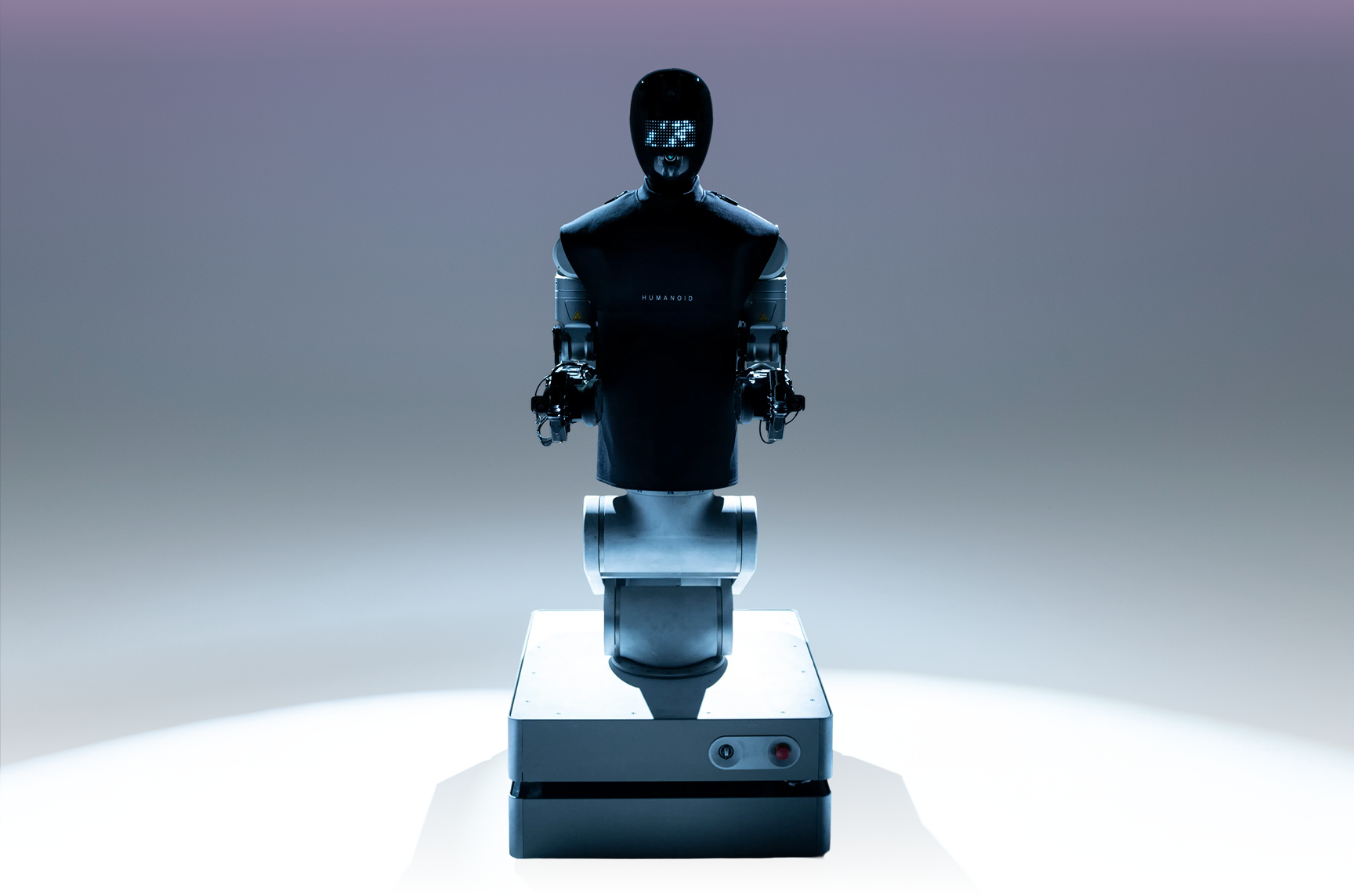
Humanoid, a UK-based AI and robotics company, developed the HMND 01 Alpha, a humanoid robot purpose-built for industrial environments. Combining an omnidirectional wheeled mobility platform with advanced manipulation capabilities, powered by KinetIQ, a proprietary AI framework, the HMND 01 is engineered to work in human-centric spaces, adapting to diverse tasks and handling complex actions. “Our mission is to create humanoid robots that perform not only in controlled lab settings, but also in real-world factory environments, handling meaningful industrial tasks. Our collaboration with Siemens and NVIDIA gives us a powerful advantage by combining NVIDIA’s leading AI infrastructure, simulation tools, and frameworks with Siemens’ deep industrial expertise and integration capabilities,” said Artem Sokolov, CEO and Founder of Humanoid. “Together, we’ve proven that humanoid robots are ready for real-world industrial deployment.”
About Humanoid
Humanoid is a UK-based robotics innovation company dedicated to developing advanced humanoid robots that enhance human capabilities. Founded by Artem Sokolov in 2024, Humanoid brings together over 200 engineers, researchers, and innovators from top global tech companies. With offices in London, Boston, and Vancouver, the company is focused on building commercially viable, scalable, and safe robotic solutions for real-world applications.
AboutSiemens Digital Industries (DI)
Siemens Digital Industries (DI) empowers companies of all sizes within the process and discrete manufacturing industries to accelerate their digital and sustainability transformation across the entire value chain. Siemens’ cutting-edge automation and software portfolio revolutionizes the design, realization and optimization of products and production. And with Siemens Xcelerator – the open digital business platform – this process is made even easier, faster, and scalable. Together with our partners and ecosystem, Siemens Digital Industries enables customers to become a sustainable Digital Enterprise. Siemens Digital Industries has a workforce of around 70,000 people worldwide.
About Siemens AG
Siemens AG (Berlin and Munich) is a leading technology company focused on industry, infrastructure, mobility, and healthcare. The company’s purpose is to create technology to transform the everyday, for everyone. By combining the real and the digital worlds, Siemens empowers customers to accelerate their digital and sustainability transformations, making factories more efficient, cities more livable, and transportation more sustainable. A leader in industrial AI, Siemens leverages its deep domain know-how to apply AI – including generative AI – to real-world applications, making AI accessible and impactful for customers across diverse industries. Siemens also owns a majority stake in the publicly listed company Siemens Healthineers, a leading global medical technology provider pioneering breakthroughs in healthcare. For everyone. Everywhere. Sustainably.
In fiscal 2025, which ended on September 30, 2025, the Siemens Group generated revenue of €78.9 billion and net income of €10.4 billion. As of September 30, 2025, the company employed around 318,000 people worldwide on the basis of continuing operations. Further information is available on the Internet at www.siemens.com.
For media inquiries, interviews, or further information, please contact: og@thehumanoid.ai
HMND 01 Alpha goes to work: Humanoid completes automotive manufacturing logistics POC with SAP and Martur Fompak
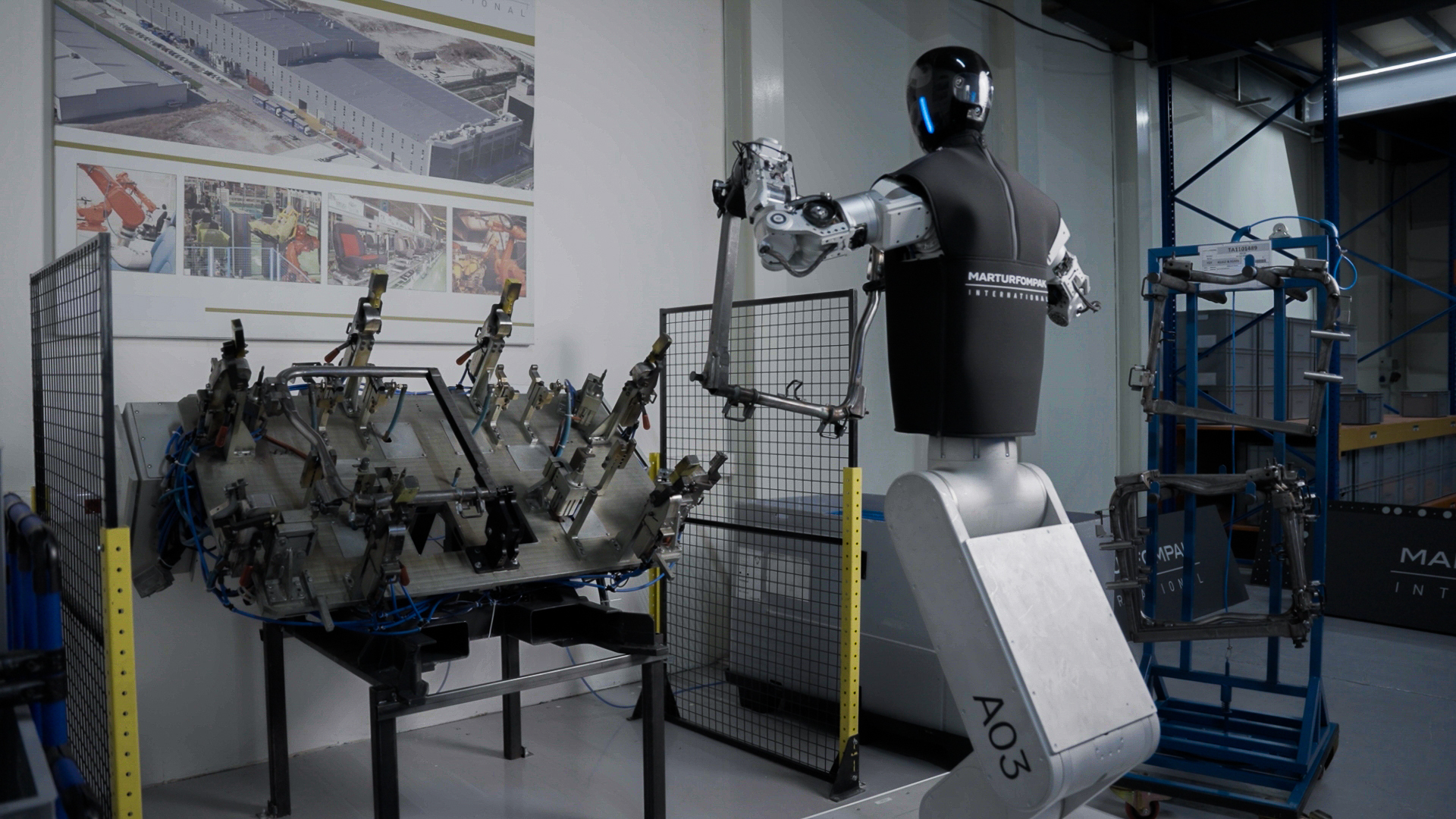
London, UK — March 30, 2026 — Humanoid, a UK-based AI and robotics company, together with SAP and Martur Fompak, has completed a proof of concept in a live production logistics environment. The project tested the HMND 01 Alpha Wheeled robot in a working production facility and set clear benchmarks for future deployment.
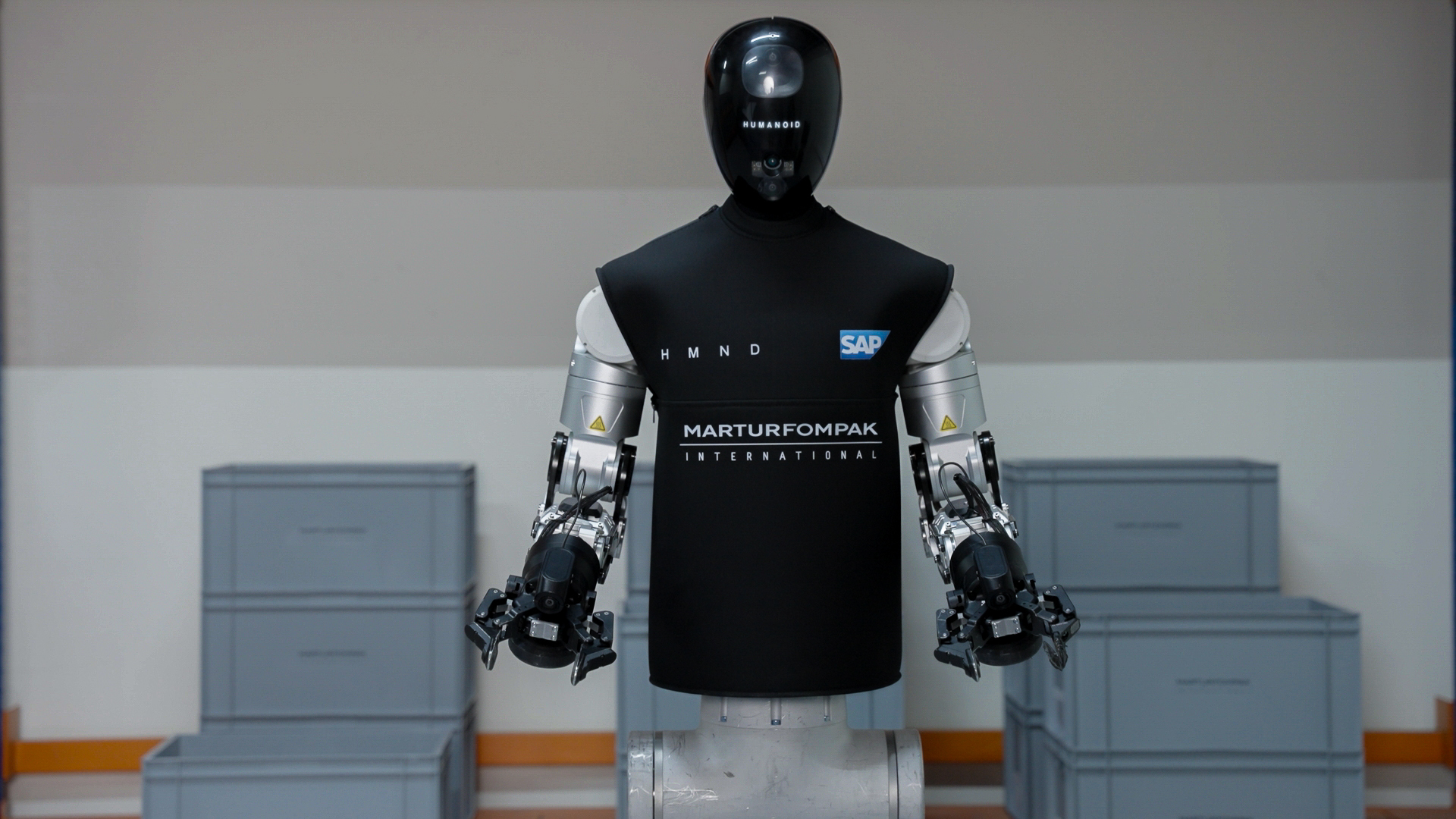
The POC focused on a real-world logistics picking workflow. During the project, the HMND 01 Alpha Wheeled robot received task instructions from the SAP AI agent, autonomously navigated to the designated pallet, retrieved a KLT box, and delivered it to a trolley. The robot then repeated the cycle as part of the order-fulfillment flow, showing its ability to integrate into existing warehouse operations.
The POC was powered by Humanoid’s proprietary KinetIQ AI stack, a four-layer AI framework for end-to-end orchestration of humanoid robot fleets across different environments. HMND 01 robots operated as a flexible fleet, directly tasked through SAP Business AI as autonomous agents, allowing the fleet to be instantly reallocated as production demands shifted. This orchestration layer ensured the robots were highly available, adaptable, and flexible.
A key milestone was achieved during the final integration phase. Humanoid’s robot API connected directly to SAP’s APIs through the SAP Joule agent layer. As a result, SAP Extended Warehouse Management was able to send tasks to the robot over the internet and manage its actions remotely, without relying on a local, custom-built control system. For Humanoid, this was the first time its robot had been controlled by an external enterprise system in a live production environment. With KinetIQ allowing robots to integrate into existing facility management structures, the robot became part of the company’s core IT system that manages orders, inventory, and tasks.
“Embodied Joule represents a fundamental shift in how robots understand and respond to business needs,” said Dr. Lukasz Ostrowski, Head of Embodied AI & Robotics at SAP SE. “This proof of concept in the manufacturing industry allows us to demonstrate how humanoid robots can act as extensions of an organization’s operations by providing business context awareness and integration with existing workflows.”
The project ran from January to February 2026 and followed a structured rollout plan: physical twin development, in-house testing, site preparation, and on-site deployment, including setup, training, optimization, and stakeholder demos. The robot delivered strong and successful results under real operational conditions. Moreover, the robot successfully handled three different tote types and operated with an 8 kg dual-arm payload limit.
“This proof of concept shows what matters: humanoid robots operating inside real production environments, connected to enterprise systems and measured against operational standards. That’s the bridge between experimentation and deployment. We’re proud of the progress we have achieved together with SAP and Martur Fompak, and are grateful to our partners for the trust to test our Alpha Wheeled humanoid where it really counts — on the factory floor,” said Artem Sokolov, Founder and CEO of Humanoid.
The team is currently preparing for the next on-site phase of the project, where the integration will be further validated in live production conditions. After completion, partners also plan to jointly assess the POC results, evaluate potential pathways to deploy Humanoid’s robots at Martur Fompak facilities, and explore more complex use cases and workflow scenarios within the production environment.
About Humanoid
Humanoid is a UK-based robotics company building humanoid robots for industrial use, working to become the #1 general-purpose industrial humanoid robotics company within two years. Founded by Artem Sokolov in 2024, Humanoid brings together over 200 engineers, researchers, and innovators from top global tech companies. All robots run on KinetIQ, Humanoid’s proprietary four-layer AI framework designed for real-world deployment.
With offices in London, Boston, and Vancouver, the company is focused on building commercially viable, scalable, and safe robotic solutions for real-world applications. For media inquiries, interviews, or further information, please contact: og@thehumanoid.ai
About SAP
SAP and other SAP products and services mentioned herein, as well as their respective logos, are trademarks or registered trademarks of SAP SE in Germany and other countries. Please see https://www.sap.com/copyright for additional trademark information and notices. All other product and service names mentioned are the trademarks of their respective companies.
Any statements in this release that are not historical facts are forward-looking statements as defined in the U.S. Private Securities Litigation Reform Act of 1995. All forward-looking statements are subject to various risks and uncertainties described in SAP’s filings with the U.S. Securities and Exchange Commission (SEC), including its most recent annual report on Form 20-F, that could cause actual results to differ materially from expectations. SAP cautions readers not to place undue reliance on these forward-looking statements, which SAP has no obligation to update and which speak only as of their dates.
Humanoid Brings Voice-Activated Multi-Robot Collaboration Powered by KinetIQ to Life at NVIDIA GTC
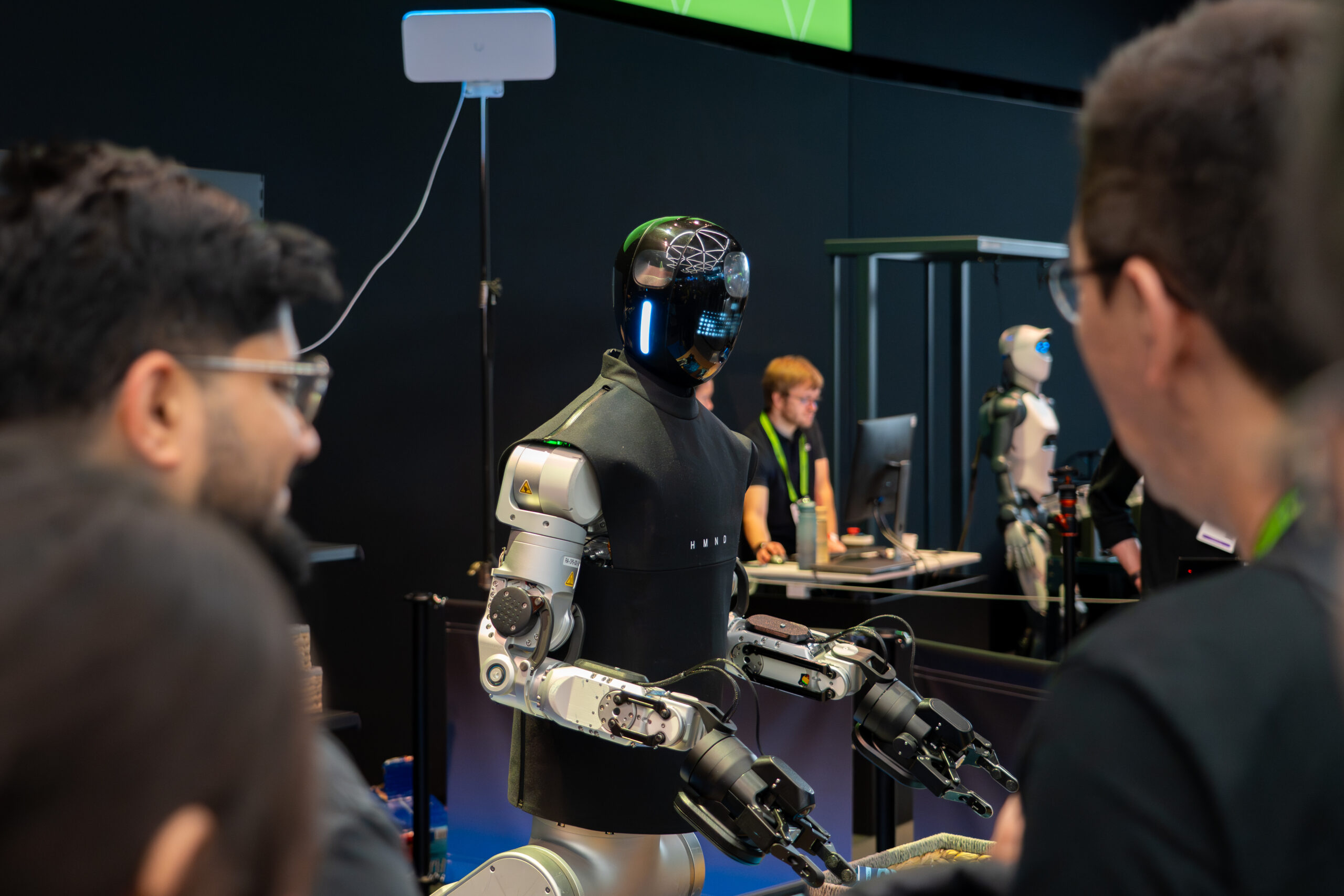
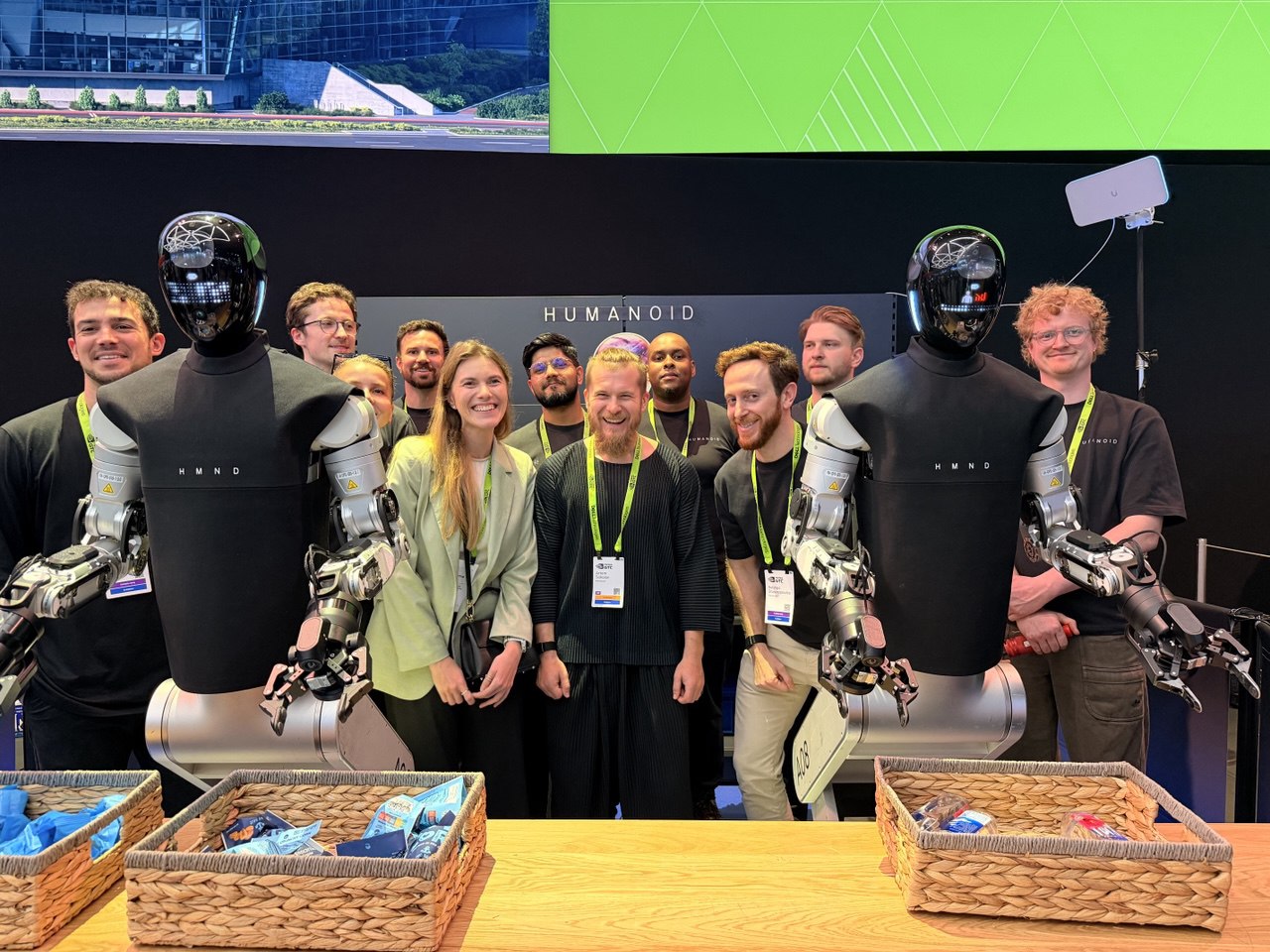
San Jose, March 20, 2026 — Humanoid, a UK-based AI and robotics company, presented a live demonstration of its multi-robot coordination system at NVIDIA GTC. Built on NVIDIA’s open robotics platform and powered by Humanoid’s KinetIQ AI brain, the system enables fleets of robots to interpret voice requests and coordinate physical actions in real time.
The demonstration featured two wheeled robots equipped with grippers operating in a simulated store environment. Using voice interaction at the booth, visitors could request the robots to handle items such as water bottles or popcorn. Once the request was made, KinetIQ’s Fleet Management system interpreted the command, dynamically assigned tasks between the robots, and coordinated the physical handover of the items. After completing each request, the robots returned to their default positions and waited for the next visitor. The system displayed real-time status updates, showing visitors how tasks were distributed and executed.
The workflow illustrated how humanoid robots can interpret human commands, allocate tasks across a fleet, and safely interact with people. It demonstrated key capabilities required for real-world deployment, including autonomous task allocation, efficient robot-to-robot collaboration, and safe human-robot interaction.
The demonstration was powered by Humanoid’s recently released KinetIQ AI stack, an end-to-end framework designed to orchestrate autonomous robotic fleets. Humanoid is building autonomous general-purpose humanoid robotic systems using NVIDIA’s open robotics platform. Its KinetIQ AI brain leverages NVIDIA GPUs for large-scale model training, the open NVIDIA Isaac Sim and Isaac Lab frameworks for simulation and digital twin development, and edge computing with NVIDIA Jetson to run real-time robotic behaviors on the robots. So, the system builds on NVIDIA’s “three computers” architecture: powerful GPU infrastructure for AI training in the cloud, advanced simulation and digital twin environments for rapid iteration, and high-performance edge computing running directly on the robots. Humanoid is also adopting the NVIDIA Isaac GR00T N1.7, an open reasoning vision language action (VLA) model to scale humanoid robot development. Together, these technologies enable fleets of robots to interpret human commands, coordinate tasks, and execute physical actions autonomously, allowing Humanoid to move rapidly from simulation to real-world deployment of Physical AI systems.
“At Humanoid, we believe the next wave of robotics will come from general-purpose systems that can interact with humans and coordinate physical actions autonomously,” said Artem Sokolov, founder and CEO of Humanoid. “Our close collaboration with NVIDIA allows us to build on the world’s most advanced AI and robotics technologies to accelerate the development of Physical AI. At NVIDIA GTC, we demonstrated how our KinetIQ AI brain makes humanoid robots more practical, scalable, and ready for real-world use. As one of Europe’s leading robotics companies, we are focused on moving beyond prototypes and preparing humanoid robots for real-world deployment as quickly as possible.”
About Humanoid:
Humanoid is a UK-based robotics innovation company dedicated to developing advanced general-purpose humanoid robots that enhance human capabilities. Founded by Artem Sokolov in 2024, Humanoid brings together over 200 engineers, researchers, and innovators from top global tech companies. With offices in London, Boston, and Vancouver, the company is focused on building commercially viable, scalable, and safe robotic solutions for real-world applications. The company is currently developing HMND 01 wheeled and bipedal platforms powered by KinetIQ, Humanoid’s proprietary four-layer AI framework.
For media inquiries, interviews, or further information, please contact: og@thehumanoid.ai
Humanoid Shows How Robots Will Work in Tomorrow’s Factories
London, UK, January 20, 2026 — Humanoid, a UK-based robotics and AI company has completed a landmark Proof of Concept (POC) at the Ford Innovation Centre in Cologne, Germany. The Humanoid team worked to deploy Humanoid’s wheeled Alpha HMND 01 robot in two complex workflows: tote handling for kitting and dual-arm manipulation of large, metal car body parts. The joint project demonstrated how humanoid robots can take on real industrial tasks in automotive manufacturing with speed, precision, and reliability.
During the POC, HMND 01 Alpha robot autonomously moved totes between workstations with eight kg payloads. The robot sustained a full hour of uninterrupted operation, twice the target, and achieved near-perfect 97% reliability in fully autonomous pick-and-place tasks given the particular conditions of the Proof of Concept. The pick-per-hour target was exceeded by 60%, with 83 units instead of the expected 50. Humanoid leverages advanced AI technology, trained on large, diverse datasets collected across multiple platforms and environments. Thanks to this foundation, this joint POC required only one hour of on-robot data collection to deliver a high-performing autonomous model.
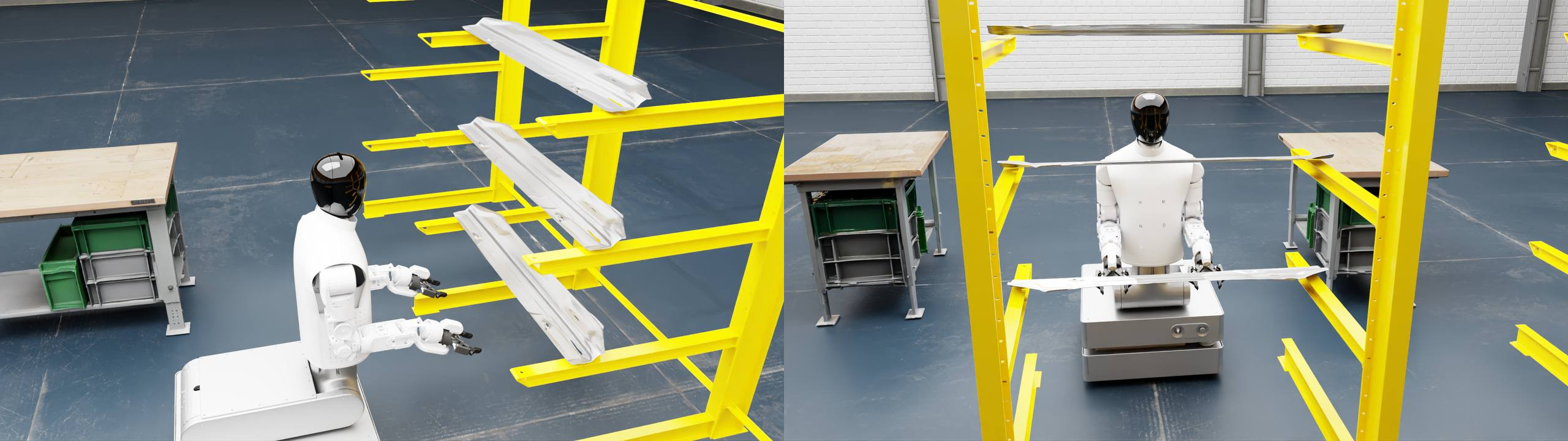
In the second workflow, Alpha demonstrated precise dual-arm handling of a thin, sheet-metal body component. The robot successfully navigated to a shelf, localized the part, lifted it securely, and placed it on the kitting table without issue. Despite the complexity of the workflow, the robot executed it safely and consistently, validating a task traditionally considered difficult for autonomous systems.
The POC was carried out in two phases: in-house development at the Humanoid Lab followed by an on-site demonstration at the Cologne plant. The on-site phase ran smoothly thanks to strong collaboration across safety, logistics, and engineering teams on both sides.
The project was built using NVIDIA’S latest technologies, including operational digital twins developed with NVIDIA Omniverse.
Building on this momentum, Humanoid and Ford Cologne are now exploring opportunities to bring humanoid robots into real production environments, with plans for further demonstrations at the Innovation Centre.
“Innovation only matters when it works on the factory floor. Our joint POC with Ford in Cologne proves that humanoid robots are ready for real industrial tasks — not years from now, but today. Our teams moved from discussion to a live on-site demonstration, and the results exceeded every benchmark. The POC showed that rapid progress is possible when both sides align on scope and maintain commitment to safety,” said Artem Sokolov, founder of Humanoid.
About Humanoid:
Humanoid is a UK-based robotics innovation company dedicated to developing advanced humanoid robots that enhance human capabilities. Founded by Artem Sokolov in 2024, Humanoid brings together over 200 engineers, researchers, and innovators from top global tech companies. With offices in London, Boston, and Vancouver, the company is focused on building commercially viable, scalable, and safe robotic solutions for real-world applications.
For media inquiries, interviews, or further information, please contact: og@thehumanoid.ai
Humanoid and Siemens Completed a Proof of Concept to Test Humanoid Robots in Industrial Logistics
London, The UK — January 15, 2026 — Humanoid, a UK-based AI and robotics company, and Siemens, a leading technology company, have successfully completed a proof of concept (POC) demonstrating the use of humanoid robots in industrial logistics. Humanoid’s HMND 01 wheeled Alpha robot was deployed in real operations at a Siemens facility, marking a significant step toward the deployment of humanoid robots in industrial settings. This successful POC is the first step in a broader partnership between the two companies to test and validate how humanoid robots can be used in real-world environments.
The POC focused on a tote-to-conveyor destacking task within Siemens’ logistics process. In this use case, the robot autonomously picked totes from a storage stack, transported them to a conveyor, and placed them at the designated pickup point for human operators. This sequence was repeated until the stack was fully empty, which demonstrated how humanoid robots can take on repetitive logistics tasks.
The POC was structured in two phases. The first one focused on in-house development and demonstration and has already been completed. During this stage, the Humanoid team built a physical twin to support testing, optimization, and rapid iteration throughout the POC. The second phase involved a two-week on-site deployment at the Siemens Electronics Factory in Erlangen, where partners assessed the robots in a real-world production environment.
This joint POC measured both performance and reliability of humanoid robots under autonomous operation. Target metrics were met in full and included a throughput of 60 tote moves per hour, operation with two different tote sizes, continuous autonomous task execution for more than 30 minutes, uptime exceeding 8 hours. The team also evaluated the POC’s success using the following indicators: overall pick and place success rate and autonomous pick and place success rate, both above 90%.
Humanoid and Siemens see this POC as a first step toward a long-term strategic collaboration — beyond the initial POC, the companies are open to expanding the scope and adding additional use cases. Partners also may progress toward a broader rollout, deploying a greater number of humanoid robots across Siemens’ facilities, based on the robot’s specific skill set.
“At Humanoid, we are a commercially driven company. Our focus is on creating robots that deliver measurable value in real-world settings. Working closely with industrial and technology partners allow us to validate our systems against real operational requirements and understand which use cases matter outside the lab. This joint POC with Siemens showed clear potential for practical deployment of humanoid robots. We see them move steadily toward the real world, and partnerships like this one help accelerate that transition,” noted Artem Sokolov, founder and CEO of Humanoid.
Stephan Schlauss, Global Head of Manufacturing Motion Control, Siemens AG, said: “As Siemens’ customer zero, the Electronics Factory Erlangen is excited to partner with the Humanoid team. We’re tackling production automation, discovering new opportunities for Siemens, and are eager to advance this promising technology across our factory network to deliver customer value.”
About Humanoid
Humanoid is a UK-based robotics innovation company dedicated to developing advanced humanoid robots that enhance human capabilities. Founded by Artem Sokolov in 2024, Humanoid brings together over 200 engineers, researchers, and innovators from top global tech companies. With offices in London, Boston, and Vancouver, the company is focused on building commercially viable, scalable, and safe robotic solutions for real-world applications.
For media inquiries, interviews, or further information, please contact: og@thehumanoid.ai
About Siemens
Siemens AG (Berlin and Munich) is a leading technology company focused on industry, infrastructure, mobility, and healthcare. The company’s purpose is to create technology to transform the everyday, for everyone. By combining the real and the digital worlds, Siemens empowers customers to accelerate their digital and sustainability transformations, making factories more efficient, cities more livable, and transportation more sustainable. A leader in industrial AI, Siemens leverages its deep domain know-how to apply AI – including generative AI – to real-world applications, making AI accessible and impactful for customers across diverse industries. Siemens also owns a majority stake in the publicly listed company Siemens Healthineers, a leading global medical technology provider pioneering breakthroughs in healthcare. For everyone. Everywhere. Sustainably. In fiscal 2025, which ended on September 30, 2025, the Siemens Group generated revenue of €78.9 billion and net income of €10.4 billion. As of September 30, 2025, the company employed around 318,000 people worldwide on the basis of continuing operations. Further information is available on the Internet at www.siemens.com.
Humanoid and Schaeffler Announce Strategic Technology Partnership
London, January 13 — Humanoid, a UK-based robotics and AI company, and Schaeffler, a leading Motion Technology Company, today announced a strategic technologypartnership. Over the next five years, the collaboration will bring hundreds of Humanoid’s robots into Schaeffler’s production facilities, fostering further industrial automation. Beyond deployment, the partnership covers actuator supply, data collection, skill development, and other critical areas.
Initial deployments are scheduled to begin with beta-stage robots in 2026-2027. This phase will focus on validating technical integration, operational performance, and compliance with Schaeffler’s system, safety, IT, and security requirements. Success will be measured across key metrics including performance, efficiency, availability, reliability, serviceability, and ease of integration. Following validation, Humanoid plans to offer its robots under Robot-as-a-Service (RaaS) models for the gamma phase, with both RaaS and CapEx options available for later stages.
Under the new agreement, the companies will also strengthen cooperation on the supply and integration of actuator components for Humanoid’s robotic platforms. They will explore the joint development of next-generation actuators, based on technical requirements and design specifications. As part of the partnership, Schaeffler will become Humanoid’s preferred supplier for joint actuators used in the wheeled platform.
As part of the collaboration, the companies will also work together on data collection and skill development for humanoid robots. This includes gathering robot-specific and use-case-driven data through teleoperation, synthetic data generation, as well as peripheral data. The collected information will be used to train AI models and continuously improve robot performance, with skills tailored to Schaeffler’s operational needs.
“Real-world integration is the ultimate test for humanoid robots. Moving from pilots to large-scale deployment requires close alignment on systems, data, safety, and operations with our partners. Our collaboration with Schaeffler allows us to validate and scale humanoid deployment with clear requirements, measurable outcomes, and long-term plans. Together, we are laying the groundwork for humanoid robots to become a practical and reliable part of industrial environments within just a few years,” said Artem Sokolov, founder of Humanoid.
Klaus Rosenfeld, CEO of Schaeffler AG, said: “As a Motion Technology Company, we want to play a key role in the growing humanoid robotics market. To do so, we are relying on our decades-long manufacturing excellence and industrialization expertise. With Humanoid, we are gaining an attractive partner in Europe that will enable us to drive forward joint innovations in the field of humanoid robotics.”
About Humanoid
Humanoid is a UK-based robotics innovation company dedicated to developing advanced humanoid robots that enhance human capabilities. Founded by Artem Sokolov in 2024, Humanoid brings together over 200 engineers, researchers, and innovators from top global tech companies. With offices in London, Boston, and Vancouver, the company is focused on building commercially viable, scalable, and safe robotic solutions for real-world applications.
For media inquiries, interviews, or further information, please contact: og@thehumanoid.ai
Humanoid Deploys NVIDIA Technologies to Power Advanced Humanoid Robots
London, The UK — January 6, 2025 — Humanoid, a UK-based AI and robotics company, is accelerating the development of its humanoid robots by integrating NVIDIA technologies — including NVIDIA Jetson Thor, NVIDIA Isaac Sim, and NVIDIA Isaac Lab — into its technology stack. These tools have powered the HMND 01 Alpha robots, now successfully tested in real-world environments, including a recent proof-of-concept with Schaeffler.
Jetson Thor drives the alpha prototype of HMND 01 robots across two platforms: a wheeled system designed for industrial environments, and a recently released bipedal robot which is intended mainly for R&D for future service and household applications. It serves as an extremely powerful edge computer that allows Humanoid to run the latest, largest, and most capable robotic foundation models directly at the edge, bringing unprecedented intelligence to the robots. Jetson Thor significantly simplifies the robot’s system architecture, wiring, manufacturability, and field service ability.
To accelerate development, Humanoid also follows a simulation-first approach using NVIDIA Isaac Lab and Isaac Sim, open-source frameworks for robot learning and simulation. For example, Isaac Lab powers reinforcement learning for improving locomotion and manipulation capabilities. The team also has developed custom hardware-in-the-loop validation with Isaac Sim, creating digital twins that use the same interfaces as the real robots. This allows engineers to seamlessly switch between simulated and physical robots when testing middleware, control systems, teleoperation, and full-body control. Isaac Sim is also used to validate navigation and manipulation policies long before the robot is deployed on site.
At the same time, simulation plays a critical role in hardware design. By analyzing forces, motion, and stability in the virtual environment, the team can optimize actuator selection, joint strength, mass distribution, and overall robot stability before building physical prototypes. This approach led to improvements in balance, durability, and performance across both wheeled and bipedal robots. As a result, Humanoid designed its first alpha prototypes in just 7 months, much faster than typical 18-24 month hardware cycles.
Moreover, for training Vision-Language-Action models, Humanoid uses NVIDIA AI Infrastructure, reducing post-training time to just a few hours.
The impact is tangible. Tasks that traditionally would take months and require large expert teams can now be achieved in a much shorter time. Today, Humanoid can train a policy from scratch and deploy it on a real robot within 24 hours.
NVIDIA’s open libraries and frameworks play an essential role in identifying and resolving potential issues early in development. Isaac Sim, the team validated navigation and SLAM performance, and analyzed stability and torque requirements. Humanoid optimized sensor and camera placement for reliable perception in real-world environments. For the bipedal robot, simulation was also used to evaluate 6 different leg configurations — it helped finalize hardware designs before physical testing and reduce potential risks.
This approach becomes increasingly important for safe and reliable deployment outside of controlled laboratory settings. As a commercially oriented company, Humanoid is focused on bringing robots into real operational environments early, gathering feedback, and iterating quickly. To date, Humanoid has already received 20,500 pre-orders, completed 6 proof-of-concepts, and has three additional pilots currently in progress.
“NVIDIA’s open robotics development platform helps the industry move past legacy industrial communication standards and make the most of modern networking capabilities. We’re currently working closely with NVIDIA and other partners on a new robotics networking system built on Jetson Thor and the Holoscan Sensor Bridge. We believe this co-developed open network standard for AI-enabled robots could make a big impact across the industry. Together, we can open the way for software-defined robots,” said Jarad Cannon, Chief Technology Officer at Humanoid.
About Humanoid
Humanoid is a UK-based robotics innovation company dedicated to developing advanced humanoid robots that enhance human capabilities. Founded by Artem Sokolov in 2024, Humanoid brings together over 200 engineers, researchers, and innovators from top global tech companies. With offices in London, Boston, and Vancouver, the company is focused on building commercially viable, scalable, and safe robotic solutions for real-world applications.
For media inquiries, interviews, or further information, please contact: og@thehumanoid.ai
Humanoid Unveils Record Breaking Bipedal Robot Walking 48 Hours After Assembly
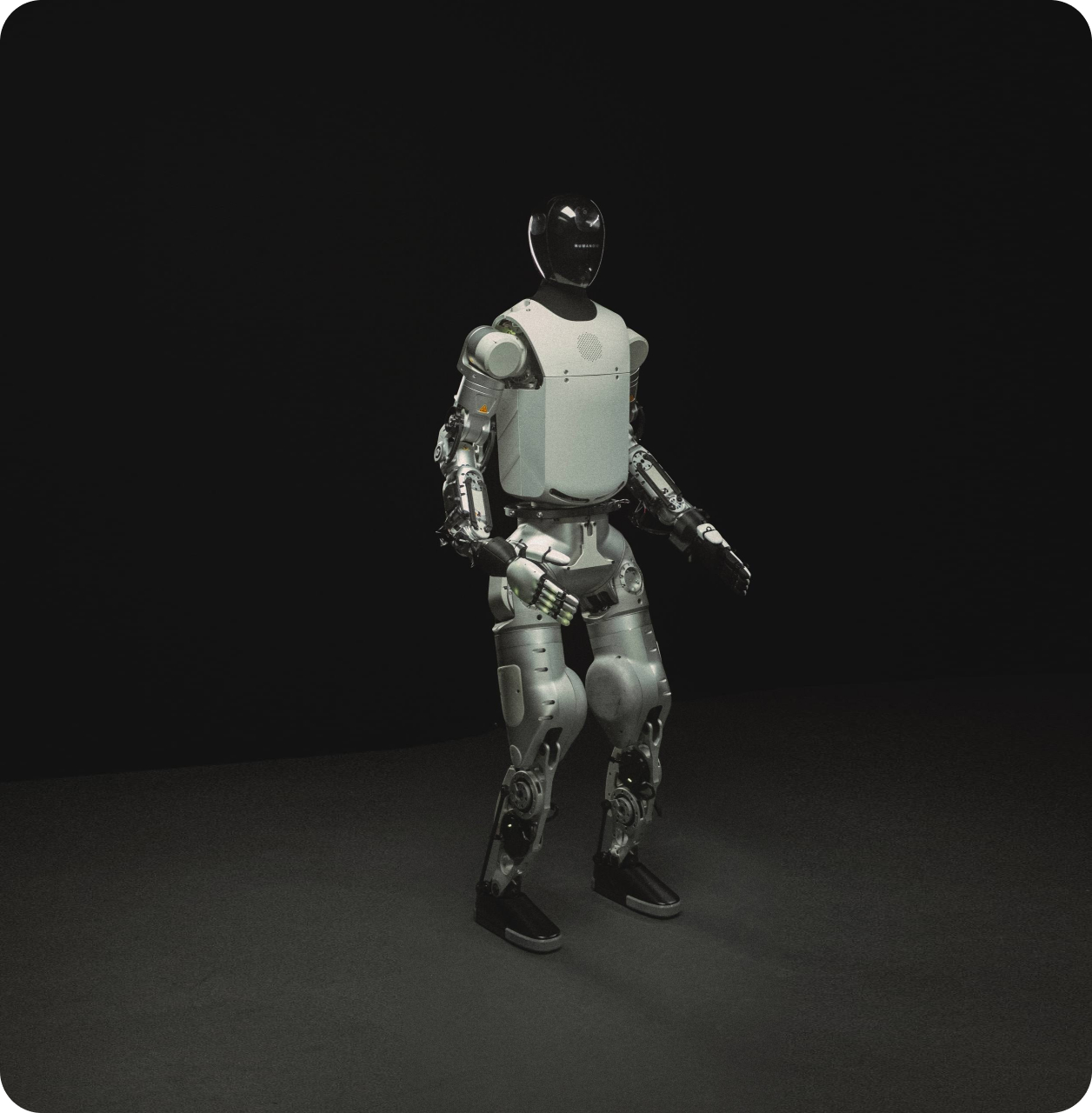
London, UK, December 2, 2025 — Humanoid, a UK-based robotics and AI company, today unveiled HMND 01 Alpha Bipedal, a humanoid robot that sets a new benchmark for development speed and operational readiness. Built from initial design to working prototype in just five months, compared with the industry average of 18 to 24 months, Alpha achieved stable walking only 48 hours after final assembly, a milestone that typically takes weeks or even months.
The secret lies in Humanoid’s approach to both hardware and software. The team relied on ultra-precise 3D modeling to create prototypes that closely match simulation, minimizing the “sim-to-real” gap that often slows humanoid development. Using Nvidia’s Isaac Sim and Isaac Lab, the team trained more than 52.5 million seconds of reinforcement-learning locomotion data in simulation, equivalent to nearly 19 months of conventional training, in only two days. The robot took its first real-world steps after just 3.2 million seconds, with minimal randomization needed to handle external pushes of up to 350 Newtons.
Standing 179 centimeters (5’10’’) tall with 29 degrees of freedom excluding end-effectors, Alpha combines top-class upper-body strength with a bimanual payload capacity of 15 kilograms (33 lbs). Its modular end-effectors can be fitted with either 12-degree-of-freedom five-fingered hands or 1-degree-of-freedom parallel grippers, while its head features six RGB cameras, two depth sensors, and a six-microphone array. The robot’s body is equipped with haptic sensors, force/torque sensors, and joint torque feedback, all powered by Nvidia Jetson Orin AGX and Intel i9 processors. Its battery provides three hours of swappable power, ensuring extended operation during testing and development.
“HMND 01 is designed to address real-world challenges across industrial and home environments,” said Artem Sokolov, Founder and CEO of Humanoid. “With manufacturing sectors facing labour shortages of up to 27%, leaving significant gaps in production, and millions of people performing physically demanding or repetitive tasks, robots can provide meaningful support. In domestic environments, they have the potential to assist elderly people or those with physical limitations, helping with object handling, coordination, and daily activities. Every day, over 16 billion hours are spent on unpaid domestic and care work worldwide — work that, if valued economically, would exceed 40% of GDP in some countries. By taking on these responsibilities, humanoid robots can free humans to focus on higher-value and safer work, improving their productivity and quality of life.”
Alpha Bipedal is designed for robust and repeatable performance across multiple applications, including industrial, household, and service tasks. It can walk in straight and curved trajectories, turn in place, sidestep, squat, hop, run, manipulate objects with precision, recover from omnidirectional pushes, and coordinate with other humanoid or wheeled robots. Beyond locomotion and manipulation, it can engage with humans via a head display, LEDs, speakers, and audio sensing, while its VLM and VLA-based KinetIQ framework enables advanced reasoning and task execution.
Humanoid’s approach emphasizes modularity and versatility, allowing future upgrades to the robot’s upper body, end-effectors, and even garments. The platform is optimized for low total cost of ownership, fast training and adoption of AI policies, and high payload-to-cost ratio.
HMND 01 Alpha Bipedal expands Humanoid’s robotics portfolio, following the wheeled Alpha platform, which was recently launched and has already completed its first commercial POCs, and extends the company’s reach from industrial and logistics tasks, including warehouse automation, picking, and palletizing, to domestic support applications.
For media inquiries, interviews, or further information, please contact: og@thehumanoid.ai